
Delphi software for clinical guidelines and consensus statements
Run the panel online, set the agreement threshold before Round 1, compare clinicians, researchers and patients per statement, and export what CREDES asks for.
No credit card. Pay per project when you launch.Set up on desktop, participants answer on any device.
Used by professors, medical doctors, researchers and students at universities and institutions such as





- and more …
Consensus where the evidence stops
Randomised evidence rarely covers every decision a guideline has to make. A structured Delphi panel fills that gap with expert agreement that is measured, not asserted.
Where trial evidence is incomplete or contradictory, a Delphi panel agrees on the recommendations before the guideline is published.
Specialist societies and working groups rate candidate statements until each one meets a pre-defined agreement threshold or is documented as dissent.
Clinicians, researchers and patients rate which outcomes every trial in a field should measure, with the groups compared side by side.
Nursing and allied health bodies agree on practice standards that have to hold across many institutions.
Built for the parts reviewers check
Clinical journals look at panel composition, the a-priori threshold, stability across rounds and per-round reporting. Each is a setting or a view in the project, not a spreadsheet you maintain on the side.
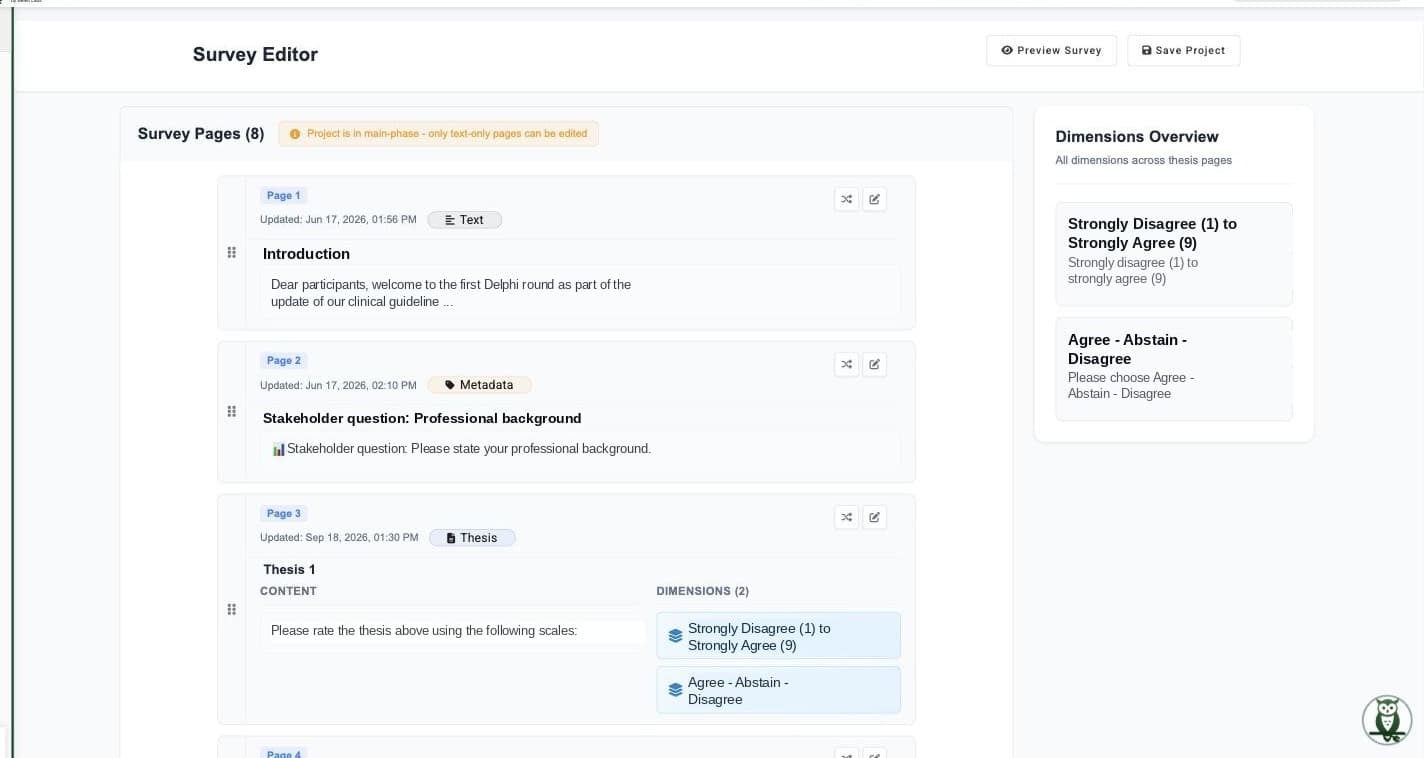
Statements, not open questions
Break the guideline into discrete statements panelists can rate individually, on a 9-point or 5-point scale with the agreement range defined per scale.
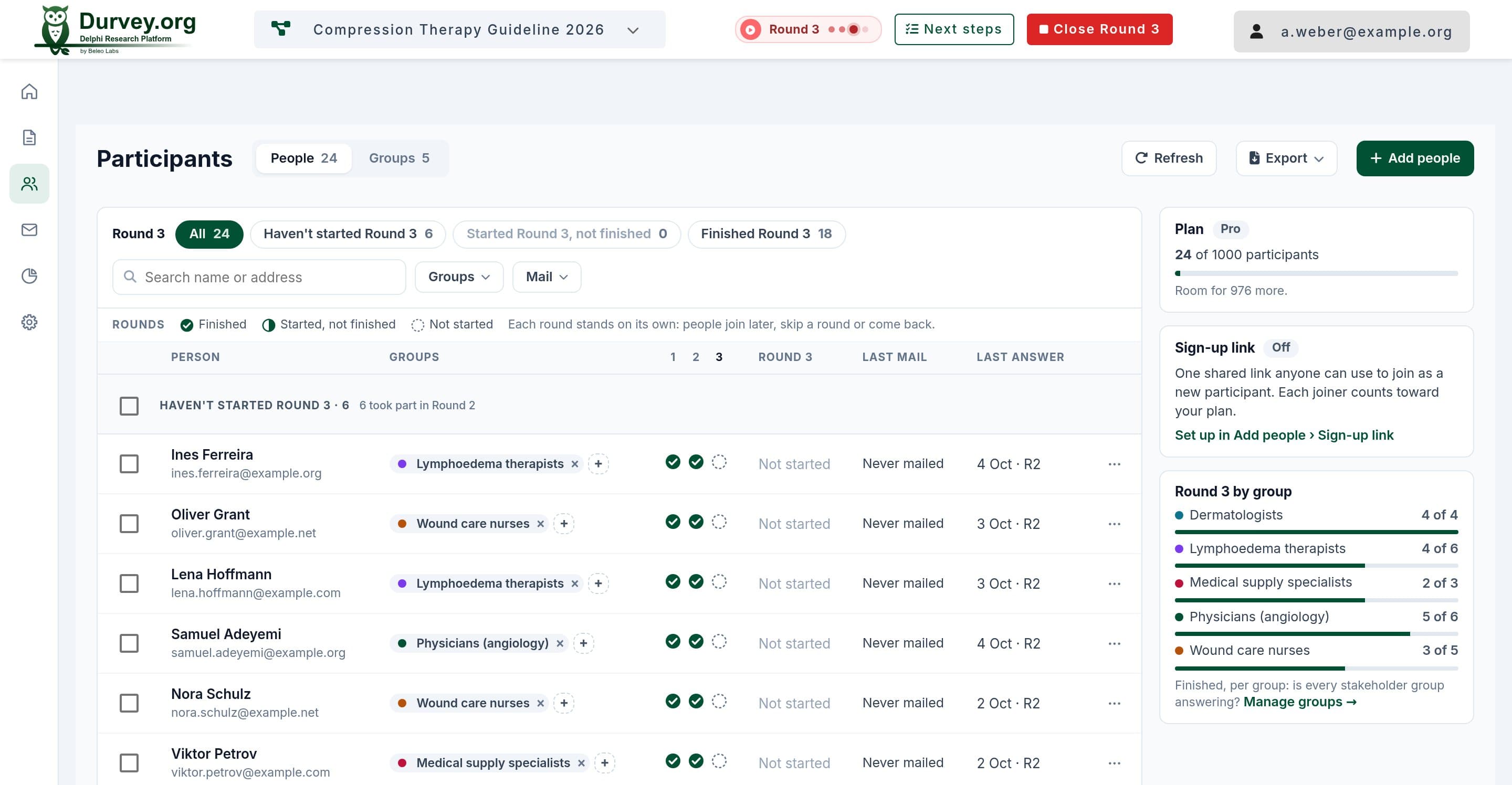
Multidisciplinary panels, compared
Tag panelists by role, specialty or region. The analysis compares the groups per statement, including a Mann-Whitney U test, so differences between clinicians and patients are visible rather than averaged away.
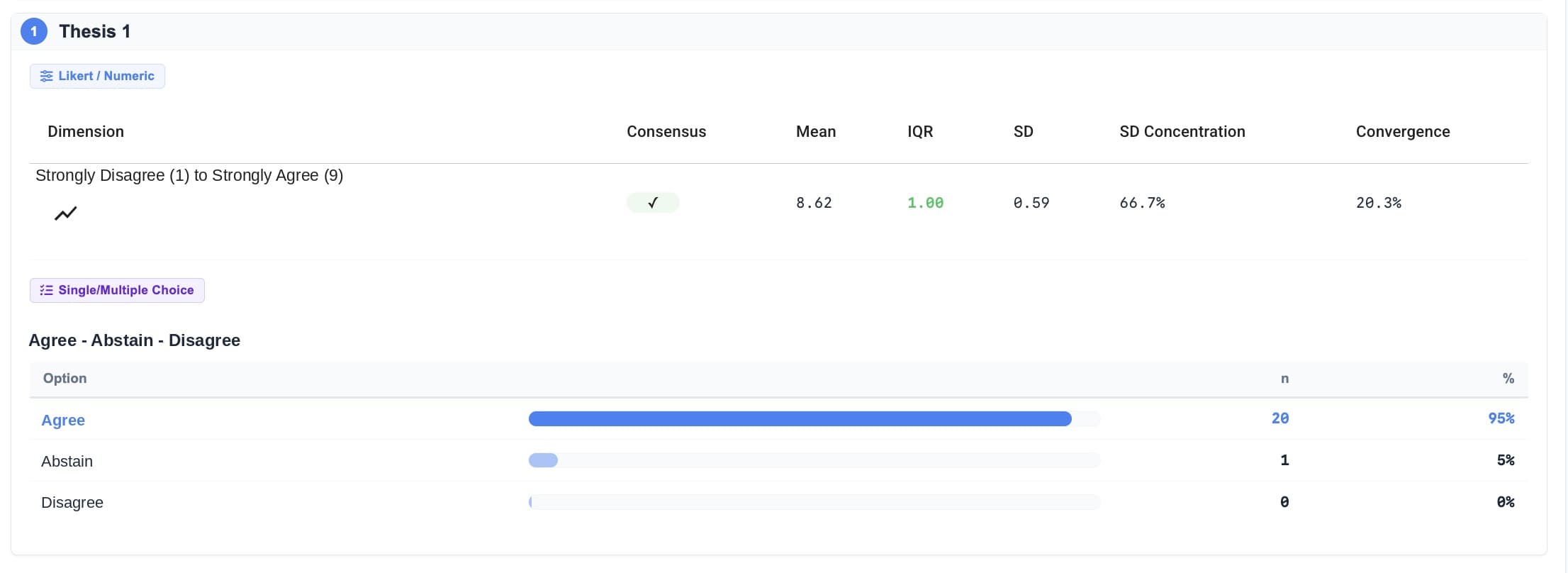
Threshold set before Round 1
Define the consensus rule per scale (for example 75 % within the agreeing range and IQR ≤ 1) in the project settings. Every statement is reported against that rule, round by round.
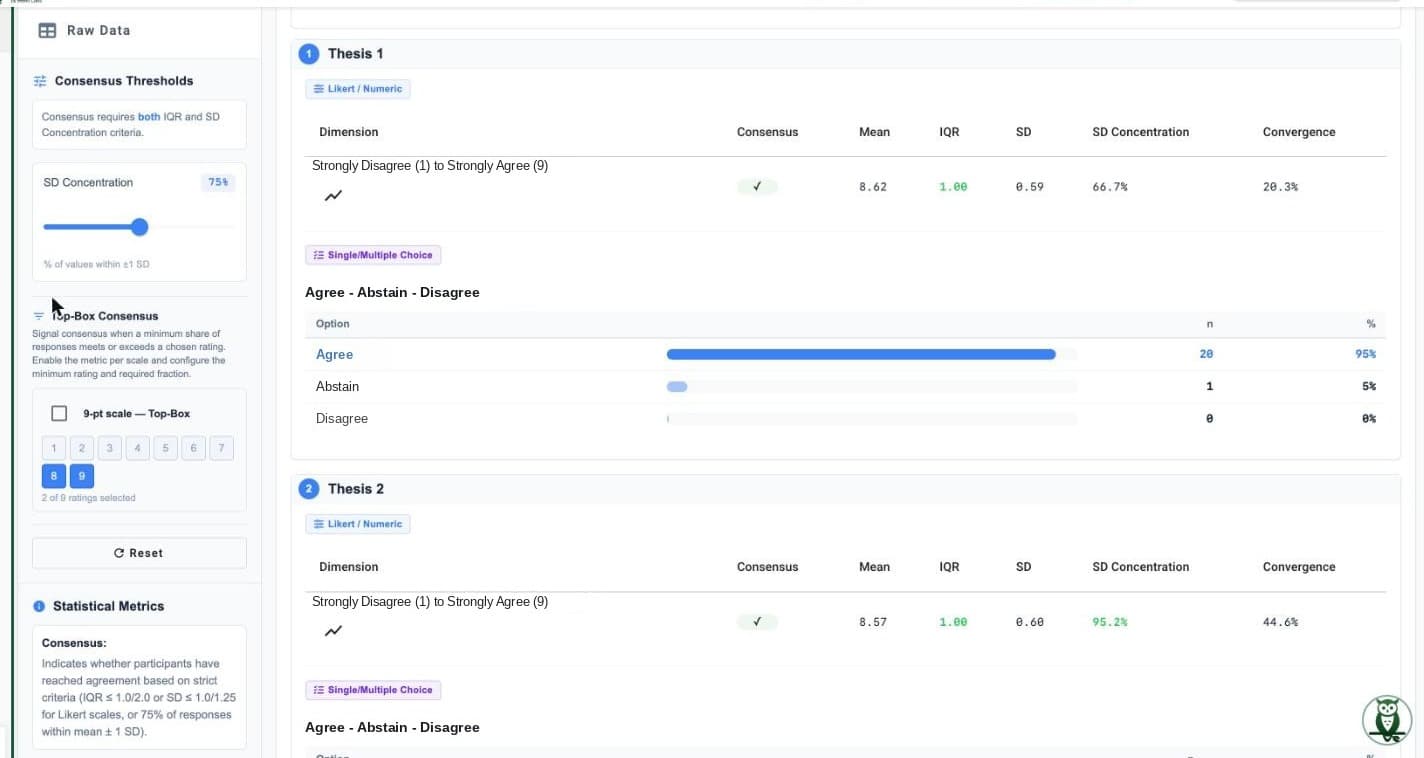
Stability, dissent and the export
Convergence between rounds shows whether agreement holds. Statements that stay divided are reported as dissent with the panel’s comments. Tables export as Excel or CSV for the methods and results sections.
Application and database run in EU data centres. Participant data never leaves the EU.
Anonymous participation and number-only panels mean you can run a study without storing personal data.
Set up your study, test it in simulation mode and pay per project only when you launch.
Guides on panel size, round design, consensus metrics and reporting, written for researchers.
What researchers say
"Durvey.org has become an important part of our teaching and research. Its intuitive Delphi setup and immediate reporting help students move quickly from theory to practice while maintaining strong methodological standards."

"Running a real-time Delphi study with Durvey.org is remarkably smooth. Everything updates in real time, which saves a significant amount of time and lets me focus on the research instead of administration."

"What I value most about Durvey.org is the automated statistical analysis and reporting. It generated clear, well-structured results across Delphi rounds without manual data handling. This saved a significant amount of time and helped me move faster from data collection to publication."
Before you start
Which agreement threshold do clinical Delphi studies use?
Most use 70 to 80 % of panelists within the agreeing range, often combined with an IQR criterion, and require the agreement to hold across two consecutive rounds. The threshold is written into the protocol before Round 1; Durvey stores it per scale and reports every statement against it.
Consensus thresholds explained →Which reporting guideline applies?
CREDES is the EQUATOR-listed guideline for Delphi studies; ACCORD covers consensus-based guidance more broadly. Both require per-round response rates, the a-priori consensus definition, and how non-consensus items were handled. Durvey’s per-round export covers the statistics they ask for.
CREDES checklist →Can patients or non-clinicians sit on the panel?
Yes. Many current guideline Delphi studies seat patient representatives alongside clinicians. Tag groups keep the groups distinguishable in the analysis, and anonymous links let participants take part without an account or an email address stored on the platform.
Comparing stakeholder groups →Real-time or multi-round for a clinical panel?
Time-poor clinicians usually respond better to a real-time Delphi, where they see the group result immediately and the study closes in weeks. If your protocol or ethics approval describes fixed rounds, run it as a classic multi-round Delphi in the same tool.
Real-time Delphi software →Where is the data stored?
Application and database run in EU data centres. Panels can be stored as numbers only, with the link list kept by you, so Durvey never holds names or email addresses of your panelists.
Privacy policy →Do I need ethics approval?
Surveying clinicians or patients about practice usually requires ethics or IRB approval, and reviewers expect the reference number in the methods section. Durvey does not replace that step, but anonymous participation and EU hosting make the data-protection part of the application straightforward.
Delphi in healthcare: practical guide →Your consensus statement, measured round by round
Set up the statements, invite the panel, and launch when the protocol is approved.